A performance by Shona Macnaughton
This performance was commissioned by Cooper Gallery, DJCAD as part of the programme for their symposium 12-Hour Non-State Parade, November 2019.
Audience MemberShona Macnaughton
CitizensThe Audience
The action takes place over within different spaces of the Cooper Gallery and it’s immediate outdoor space, Duncan of Jordanstone College of Art, Dundee.
Scene 1.
The Roundtable discussion has ended and they have opened to the floor for questions. The chair makes time for one last question. The Audience Member puts up their hand.
The Audience Member
takes the microphone and speaks tentatively to the panel
I can’t think of a question. I can never think of a question. My chest is pounding. I want to speak but there’s a gap between how intelligent I think I am and how intelligent I sound.
Can you help me?... Can you look after me? I really need you to look after me. Irrate I really need you to look after me. ….Do something!
turns to the audience and sighs
What has happened to us?, to the values we used to share? The balance has increasingly tilted in their favour. motion at those on the panel At the expense of your individual freedom...But, our relative decline is not inevitable.
takes off jumper, reveals top half of costume
Smiles, gets up Will you take care of me? The Cooper Gallery have diminished your role. Now I want to work with the grain of human nature, helping you to help yourselves—and others.
—Watch yourselves very closely for a few minutes to see when you’re ready to help …not me… takes off trousers ...yourselves... motions to audience back and forth to indicate they watch themselves
You can try to work out when you’re ready….pause…Being patient with each other will help us get it right, even if you feel frustrated… pause ...You need to watch for the signs that you are ready to start… pause ...picking and pulling at upper arm revealing 1980 - fidgeting, pulling at our clothes, interest in others - … pause...In the meantime, the best thing you can do is to encourage the behaviour you want.
Shows arm displaying 1980 This performance sets out a broad framework for your recovery, based not on dogma, but on rrreason, on common sense, above all on the liberty of the people under the law.
If you get the idea and manage to leave with me, now, that’s great. But I will never push you to perform. This is the way to restore that self-reliance and self-confidence which are the basis of personal responsibility and performance success.
Moves out of banked seating staying close to one edge
If you don’t want to sit on it that’s fine. I’m not going to restrain or force you to sit here We all have the odd accident, especially when we’re excited, upset or absorbed in something else. I will never blame you.
The decision is yours alone. Motion to door. The most important thing to remember is that…
TIME REALLY, REALLY MATTERS! The sooner you come with me, the more options and control you will have.
Some women may be certain while others…That’s it.
You may know straightaway that you do not wish to continue, but
often people feel uncertain or confused initially.
Whenever
possible, you should be given a choice of how you would like this
to be carried out.
As people get up repeat words of encouragement
We are dry most days!
High five!
Thats it...
Well
done!
We have no intention or desire to replace one set of dogmas by another. Turns arm over to reveal 2000
Scene 2.
The Audience Member moves out into the upper foyer space of the gallery where other members of the audience have been led out to and are gathered. She picks up a megaphone and turns on the lights.
Emotionally you may experience many feelings. What counts is what works. The objectives are radical. The means will be modern. We’re going to start by holding on for a short while while you get the urge. Motion to and hold on to the upper staircase bannister
On a breath out, pull up and in, and squeeze. Squeeze the banister, eyes closed Sharing values and purpose, where merit comes before privilege—squeeze—Trying to hold on increases the amount you can cope with—squeeeeze—This will help any swelling, bruising or tears—squeeze—The vision is one of renewal, an audience with drive, purpose and energy.
Walks down to lower staircase bannister. Try to slowly increase the time that you can hold on for. Squeeeeze. Squeeze the banister It is likely you’ll experience some discomfort but in most cases these symptoms are only slight and nothing to worry about.
Move into the stairwell area This is all designed to cause you to pass me. Door is opened and held open by staff Your need to pass may be triggered by a sudden change in my position. It is likely to be identifiable. We each need to feel closely identified with each other. I should experience a warm, intimate and continuous relationship with you and you need to feel the expansion of your personality in my personality.
Institutional Care and the Feminine Aquatic.
A conversation between Angeliki Roussou & Shona Macnaughton
I can’t think of a question. I can never think of a question. My chest is pounding. I want to speak but there’s a gap between how intelligent I think I am and how intelligent I sound. Can you help me?... Can you look after me? I really need you to look after me. Irrate I really need you to look after me. ….Do something!
For the opening act of Aquatic Needs, Shona Macnaughton was sat amongst the audience as she directed this series of questions to a semi-baffled panel of speakers, in the context of the “12-Hour Non-State Parade” Symposium, at the Cooper Gallery in December 2019. Macnaughton then stood up and removed her regular art-world clothes, revealing a year-date embroidered costume which gave us visual and textual cues to her scripted concept. The forcefulness of Macnaughton’s speech gradually increased; she was now using a megaphone and urged willing attendants to exit the symposium room and follow her around the gallery. As she guided us from one room to the next, she encouraged us to consider our own agency as an audience and physically interact with the gallery interior. Her monologue climaxed outside the front of the gallery, where Macnaughton urinated on herself while flashing a torchlight on her crotch, where (prophetically?) her costume displayed the year 2020.
While the Scottish artist’s script humorously repurposes manifestos of British political parties (from 1979 to 2019) and female public-health literature, the performance ultimately evokes a gendered liquid physicality more literally than allegorically. Aquatic Needs seems to focus on the psychosomatically loaded mishaps that sometimes underpin creative authorship. The performance dares to intimate the connection of such mishaps with forms of collective obligation and labour division encountered in motherhood, State-citizen and author-institution-audience relations of care.
How was the locality of Dundee relevant to your performance?
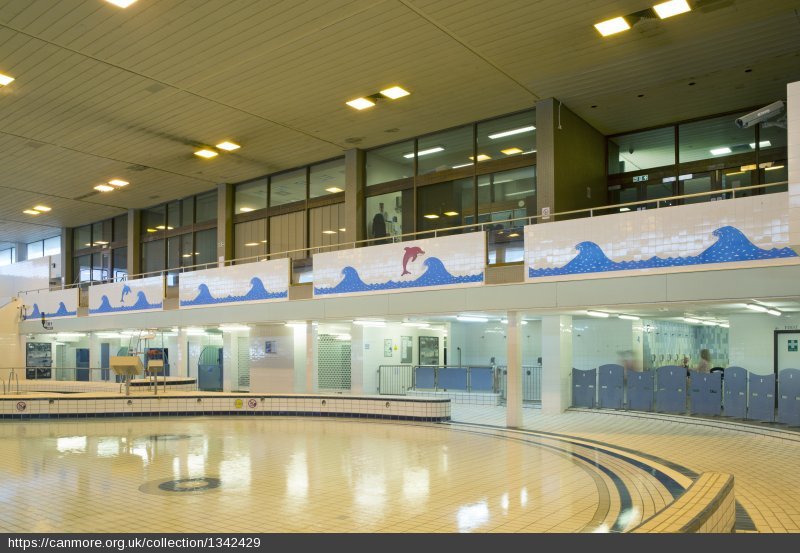
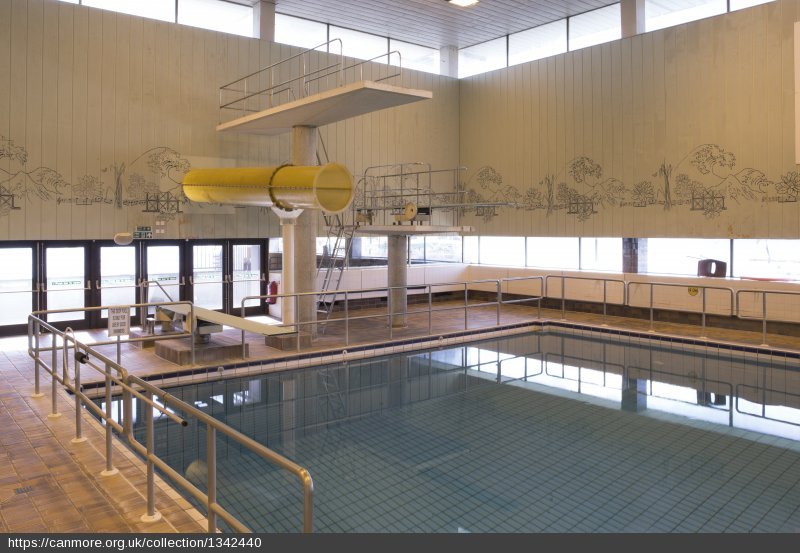
I tend to work from site or scenario specificities. I began from my personal memory as a child of Dundee’s architecture in the 1980s and 1990s: degrading modernist edifices, grand planning half-remnants, dank walkways and concourses, alongside functional civic entities: libraries, swimming pools, council offices, car parks. This history has been pretty much erased from Dundee’s waterfront. The new V&A museum (2018) stands on the site of the former Olympia Swimming Pool, while the contemporary waterfront redevelopment, of which the V&A is one part, has its own website with promotional texts such as: “Western Europe's most extensive and transformative waterfront projects.”
I was thinking about Dundee’s history of modernism in relation to how the state’s role has changed from civic provider to manager and enabler of market forces. I wanted to explore the language shifts in this local history. Looking at newspaper clippings from the late 1960s and early 1970s, there was a distinct lack of property developer rhetoric or promotion, as well as a lack of transparency. Building the Olympia was about providing a functional resource for the city and its residents and it was explicitly about their health. However, the modernist development was imposed without the contemporary consultation processes.
I considered using in the performance the contrast between the promotional architecture text of now and the top-down announcement of modernist projects within the press, but instead I opted for the language which got us there – the language through which the political class contributed to the material history of the city,and many other cities in the UK : The conservative party’s manifesto text from 1979, the Labour party’s text from 1997 and a collage of all political party manifestoes proliferating at the end of 2019, ahead of the UK general election. I was thinking of these texts as respectively roughly 20 years apart, and spanning a 40-year history. The script’s vocabulary was also influenced by the specifics of the symposium: its title (“12-Hour Non-State Parade”) and stated intention of "Referencing the hidden mechanisms of state power, modernist architecture and the disciplined body”.
Walks down to lower staircase bannister. Try to slowly increase the time that you can hold on for. Squeeeeze. Squeeze the bannister. It is likely you'll experience some discomfort but in most cases these symptoms are only slight and nothing to worry about.
How was the aquatic element relevant to your performance, as it fluctuated from states of authoritative speech to statements of vulnerable dependence?
I set out to relate the specific research into Dundee as a waterfront and how the aquatic has played a particularly materially prominent role in the city’s political history to the performing body. I considered what it would mean for me to speak this political-manifesto language to an audience in the present, as a singular female body. I was then thinking in a more materially abstract sense about Water, the different stages that the body might go through aquatically, as the female body aged. Whilst I was developing this performance, I read a post-human rereading of Luce Irigaray by Astrida Neimanis:. “For Irigaray, feminine bodies are fluid, both figuratively in their non-subsumability into a masculine paradigm, and literally in their genital mucosity, their placental interchanges, and their amniotic flows. This leakiness is what makes woman always a woman-to-come” (78). This interpretation proffers the opposite of the essentialist readings of fixed gender, which are often levelled against Irigaray. This sense of fluidity, as a characteristic of the feminine in itself, and the idea of leaking, as the feminine being able to seep through evading capture, shifted how I wanted to use that initial research into the architecture of Aquatic Needs. The aquatic was abstracted onto my body as the performer, and then the question was how to imbibe the sense of the substance onto the political language, taking Irigaray as a model, both figuratively and literally.
A framework was thus shaped in which the watery female body (me, the performer) would embody the forty-year-old neoliberal state. The performance would echo a trajectory of mucosity; the 1980s/90s – toilet trained, periods; the 2000s – abortion, periods; the 2020s – children, incontinence, no periods. I used language from female public health literature and combined it with the political speech of manifestoes so that the performance script would also reflect the implicated ideological transformations. The shifts in power emerge somewhat intuitively through the amalgamation of different languages and the way they form an address to the audience. The instructional aspect of the public health advice takes an authoritative tone, but also translates into actions which I perform, making the bodily text refer to my body, and undermining that authority, as I become vulnerable and dependent. (See also the opening question.) In combination with the declamatory style of the manifestoes, the performance rhetoric sounds almost like a personal mantra that has turned intersubjective and points to collective self-care.
By testing the audience with rhetorical questions but also letting them off, I aim to maintain a balance, whereby I have the power as the performer but I’m also the figure of ridicule. I speak directly to the audience as if they are participants or as if they should join me in my actions, even though, ultimately, they remain an audience. In a sense it is the playing out of the theatre of participative democracy.
Talent and genius are uniformly distributed. Opportunity is not. This means that you will have trouble controlling yourselves -Part of becoming a woman is dealing with embarrassing mishaps. We understand the concept of aspiration. It may leak out at times when you are under pressure; for example, when you cough or laugh hahahahahaha...
Laugh until I pee myself.
Shine torch down legs.
How did the dates and designs on your clothes operate as props or signs?
The dates on the clothes operate as literal footnotes on the body, indicating the time period that the script refers to. They were intended as visual signs that illustrate the shifts between the design cultures of different periods; the fonts and swimming symbols are taken from the Olympic Games of those years: the first one –‘1980’ (Moscow) – is late Soviet; the gestural and lively ‘2000’ is for Barcelona; and, obviously, the lean, slick ‘2020’ would have been Tokyo. . With this I was exploring how ideological shifts were visible in that design and how the aesthetic and chronological space between the dates might represent the progression of neoliberalism.
In addition, I wanted the way I moved my body or indicated with my body to be determined by their position. So, they also functioned as props, giving a key into the the particular period that the script referenced.. The ‘1980’ was placed on my arm as I gestured to people to move out of the symposium space; the ‘2020’ on my crotch meant I rolled in on myself as I urinated through the text about incontinence. The future date stamped across the female crotch was also intended to be funny, a sort of feminist performance joke.
What counts is what works. The objectives are radical. The means will be modern. We’re going to start by holding on for a short while while you get the urge. Motion to and hold on to the upper staircase bannister revealing inner arm 2000. “New Labour is a party of ideas and ideals but not of outdated ideology. What counts is what works. The objectives are radical. The means will be modern.” (Tony Blair, 1997).
I’m wondering whether or how your employment of the feminine aquatic / fluid quality or the female public-health literature ties into institutional conditions or infrastructures of care and creativity.
So the question would be is Irigaray’s woman-to-come speculative? I think seen in conjunction with its literal counterpart of the female health literature there is something which shows the feminine aquatic is a different kind of flow to the speculative circulation of late capitalism an abject non-productive flow, like the wasted leak in the performance.
These artistic-political discussions about individual subjectivity and how the state has de-collectivised our psychology (neoliberal political rhetoric), when seen through theories of the feminine and gendered institutional language (female public health), should speak about the biopolitical seepage which burdens the clean flow of capital. My work in general is a camp over-identification with these seepages; pointing to how, ultimately, the system we live under is unfeasible. Care is difficult, or the infrastructure of care we have makes it difficult. Shifting language that is used by the state at a macro level and towards the female body, to an audience interaction at the scale of performance is simply about seeing what happens: how those specific conditions of collectivity possible within a live performance play out in a utopian environment where history can collapse and be tested.